International — 25 Aug 2026 — 2′ read
Burnham’s Guitar and the Theatre of Solidarity
Yesterday in Kyiv, Andy Burnham picked up a guitar. It was the new Prime Minister’s first trip abroad, timed for Ukraine’s 35th Independence Day. He laid a wreath for the fallen, co-chaired a meeting of the Coalition of the Willing, walked through a shopping centre that a Russian missile destroyed in May, bought fruit at a market, posed for selfies. And at some point a soldier handed him an electric guitar. Music, he said, can lift spirits on the front line.
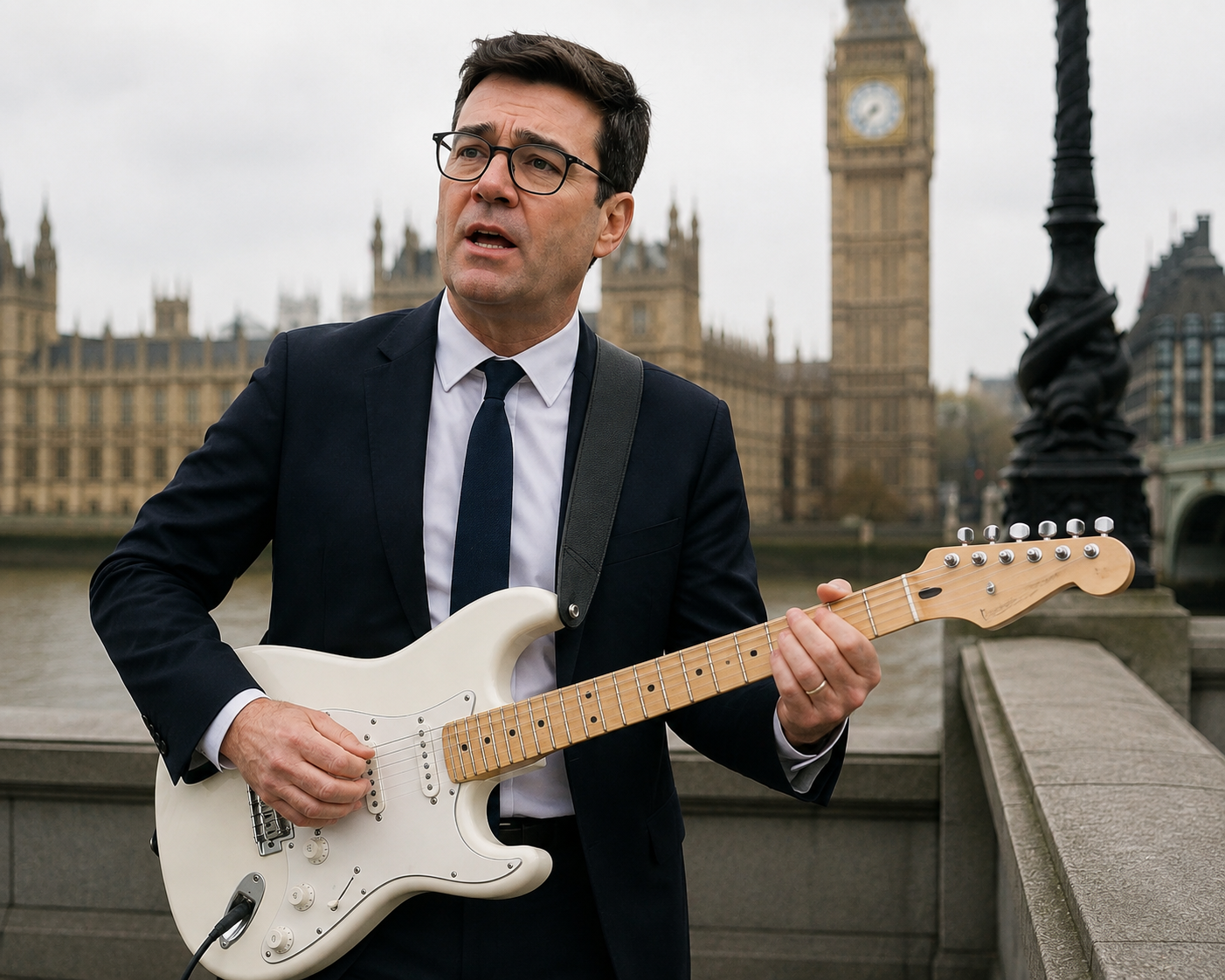
We have seen this show before In May 2024, Antony Blinken strapped on a red electric guitar and played with a local band.
Different politician, different room, the same political genre.
These moments are not accidents of spontaneous warmth. There was a pool photographer there. The Prime Minister posted the video on his own social media the same day. Somebody sat in a room and decided that the Prime Minister of the United Kingdom, visiting a country in the fifth year of an invasion, should be seen doing something human and unstuffy rather than standing in a hard hat next to a drone production line.
The question worth asking is not whether it works. It’s who it works on.
It does not work on a soldier in a dugout on the eastern front. It works on the audience back home — the voters who find a politician with a guitar more likeable than a politician with a briefing folder, and who will absorb, without having to read a word about missile transfers or coalition financing, the general impression that their leader is a decent bloke doing a decent thing.
It is domestic communication conducted on Ukrainian soil, using Ukrainian soldiers as the set.
Burnham said music lifts spirits. Perhaps it does, for an evening. But morale is not a mood that visitors bring with them in the hand luggage. It is a rational response to circumstances, and it moves when the circumstances move.
Morale goes up when a village comes back onto the map in your own colours. When the air defence holds through the night and the children sleep in their beds instead of a corridor. When the rotation happens on schedule, the pay arrives, the wounded are treated and come home. When the state functions, the courts work, the thieves in procurement are prosecuted, and there is a believable story about what kind of country this will be in ten years. Territory, security, democracy, accountability, a future.
And it runs the other way too. Morale is not built by striking civilian infrastructure — not Ukrainian infrastructure, not Russian infrastructure. Body counts are not a scoreboard. Killing thousands upon thousands of people can look like winning, in a headline or on a map, but it isn’t. It is what a war does while the question of who is winning remains unanswered.
Thirty-five years of independence, five of them under invasion. Ukraine has been serenaded quite enough.